

POT LUCK
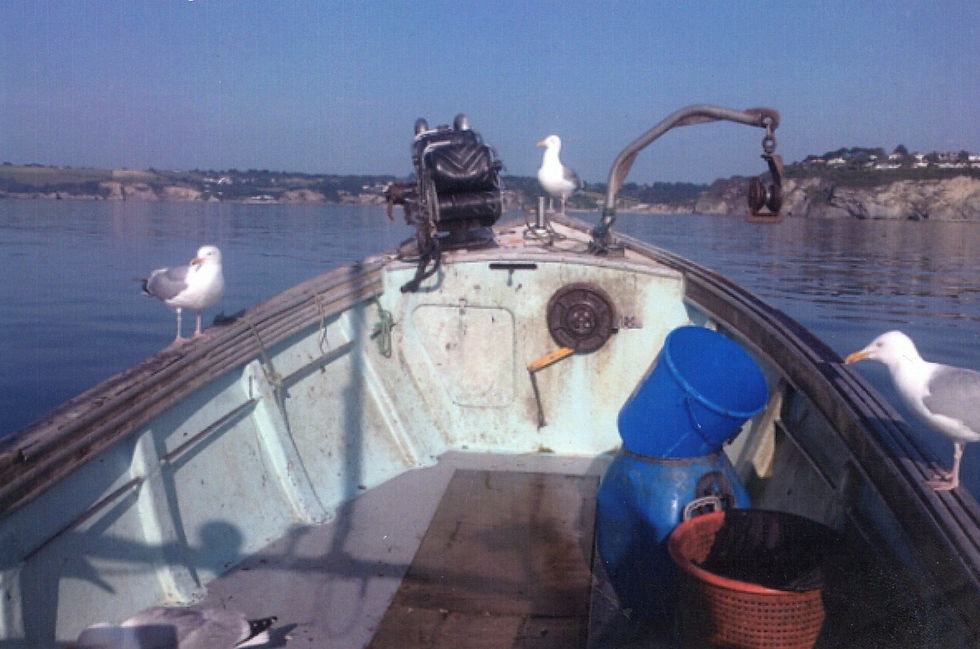
My memories of working lobster pots along Appletree Cove towards Crinnis Beach.
My first memory of seeing a traditional Cornish willow lobster pot break the surface is one that has stayed with me throughout my life. I was about five years old at the time. For ages, I had pestered my neighbour, Bill Kelloway, to take me out in his fishing boat. I never really thought he would, but eventually, he did.
Bill had a little clinker-built wooden boat named “Suki,” which was varnished rather than painted. He lived at number 55 Front Row, while I lived at the far end of the street. Across the lane from his front door stood a brass tap, where cooked shellfish were often laid to cool under the cold running water. That’s how I knew Bill caught crabs and lobsters; whenever I walked past, they were there beneath the tap.

The First Pots
I can still remember going down to the quay and climbing the granite steps on Banjo Quay. As a small boy, they were hard to manage; even as an adult, they never became easy, and I have climbed them most summer days for nearly 50 years, man and boy. The boat was already in the water, fitted with a Seagull Century petrol outboard motor. Even now, as I write this, I can still picture the smell of petrol mixed with the stench of bait for the pots.
We cast off and motored out through the gaps, across Big Beach and east towards Appletree Cove. Our first pot lay beside Half Tide Rock, marked by a black-painted aluminium ball. Bill told me I could gaff it with the hook, which I proudly did before passing the rope to him. By then, he had put on his black waterproof apron. After a few steady pulls, a willow pot broke the surface. Inside were a couple of large spider crabs, which Bill dropped into a wicker basket. He took out the old bait but, instead of throwing it overboard, tossed it into a wooden box. “There’s no need to give a lobster a free meal,” he said. “Keep them hungry.” He then added fresh bait and searched for the right place to set the pot again: a sandy pool in the middle of a rocky patch, where lobsters would wait around the weeded edges for prawns or any other unsuspecting prey.
We then proceeded to the next lobster pot, located outside the adit of Appletree Mine, where the coastwatch station stands today. My excitement was almost overwhelming. As we brought the pot aboard, something thrashed around inside. To my amazement, a lobster, dark blue with black tones, was waiting at the bottom. Bill estimated it weighed a couple of pounds, but as a child, it seemed enormous to me. He swiftly reached in and lifted it out. The lobster immediately came to life, bending its claws back over itself in an attempt to grab Bill's hand. He quickly dropped it into the basket and covered it with a wet rag. In total, we had a dozen pots to haul that day.
The next two or three pots were close together beneath a cliff that was home to a large colony of seabirds known locally as green-crested shags. These birds dislike human disturbances, so their nests are typically located in isolated places. Fishermen have dubbed this area the Shag Roost. If you've ever travelled along that cliff by boat or kayak, you might recognise it by the old mine shaft that has crumbled at both the top and bottom, creating a smooth semicircular opening in the cliff face. The middle sixty feet of the shaft remains intact, so from a distance, it appears to be an ordinary cliff; only from below can you look up through the shaft.
When we stopped and picked up the next float and began to haul the pot, I had the fright of my life. The water seemed to explode as the pot broke the surface, revealing a conger eel of about 8 lb. Bill wrestled with the pot, turning it upside down and hoping the slippery, manic creature would fall out, but the neck, or entrance, was only about six inches across.
It would not come out. In the end, Bill put his hand into the pot and flipped the eel’s tail towards the opening; the rest of it followed. Conger eels can swim backwards because, unlike most fish, they do not have gill plates, only a small opening.
The eel then thrashed around at my feet, and I jumped up onto the thwart. Then, all at once, it went overboard. I remember thinking, thank God for that.
Later Memories with Bill

We set out to pull a few more pots beneath the Carlyon Bay Hotel, on a rock formation known as the “Range.” That day, we managed to catch three more lobsters, bringing our total to four. I also remember Bill giving me a large brown crab that weighed about 5 pounds. I carried it home as if it were a precious gem. My mother cooked it, and believe it or not, I didn’t like it at the time. That perspective changed as I grew older, and now I find myself craving it.
I spent much of my childhood out on the boat with Bill, working with pots, nets, and handlines. We would catch prawns for bait and keep them alive in a keep pot hanging from the harbor wall. In the evenings, we’d head out to a patch of rock about half a mile off Appletree Cove, anchor, and fish with live prawns for pollack. I clearly remember one evening when I caught a fish weighing 8 pounds. I also distinctly recall seeing Dutch fishing boats anchored in St Austell Bay. On one occasion, we pulled alongside one and saw that they had divers on board, diving for large crawfish. To be honest, they cleaned out the crawfish population in St Austell Bay. When I began commercial fishing in 1982, the only places where you could still catch a few crawfish were Lantivet Bay and Owen Rock, which is known locally as Foghorn.

Crabbing at Scale
When I started crabbing in earnest, I worked a great deal of gear. In 1982, Raymond Endean of Par told me that he and his father worked only from Par to Gribbin with 125 lobster pots, yet they would often catch more than a hundred lobsters in a day. I have hauled 125 pots for no lobsters at all. By the 1990s, good fishing for me meant one lobster for every three pots; poor fishing could mean one for every 300. Times had certainly changed.
The old willow pots, known as withies, had their drawbacks. After about 48 hours, they could lose their catch, and they broke up easily in heavy weather. Modern steel pots lasted around five times longer, and parlour pots made a big difference too. A parlour is a separate section within the pot, entered through a netted tunnel with a flap that closes behind the animal. These pots were more efficient and would hold their catch even if you could not get back to them for a week.
At my busiest, I hauled 150 pots six days a week, most of them fishing for two nights. My routine usually worked like this:
· 150 pots from Charlestown to Blackhead
· 150 pots from Charlestown to Gribbin Head
· On the third day, back to Blackhead again
The pots were set in strings of 15, each one spaced 72 feet apart, so if I had enough bait, I would try to haul 10 strings a day. It was always a challenge. In spring, lobsters could be very close inshore, so I would work as near as I dared. But you had to be wary of an east wind, because a change in weather could wash pots ashore if you were not careful. When strong onshore winds were forecast, I moved the gear into deeper water, trying to keep about 60 feet of water over the pots at low tide. When the weather settled, I pushed back into shallow water again.

The Rewards and the Cost
I could make a living from crabbing, but it was hard work. Keeping that amount of gear going took a great deal of bait, and I always caught my own rather than buying it. I worked nets to supply what I needed, which added another layer of labour to the job.
I remember one spring morning hauling a string of 15 pots set around Appletree Cove and Half Tide Rock and finding 13 good lobsters. Later that same day, I pulled another 15 pots off Spit Beach and found 15 lobsters, one in every pot. Then I hauled another 100 pots for just three more. That was fishing: one stretch could be full of promise, while the next gave you almost nothing.
My best day’s catch at Charlestown was 44 lobsters. I loved the way of life, but it was punishingly physical work. The pots were heavy, and year after year they took their toll on the body. By the time I was 40, I was suffering more or less constantly with sciatica, backache, and arthritis. I gave up crabbing at 47, and the aches and pains soon went away. I still miss my beautiful office in St Austell Bay, but I do not miss the pain that came with it.
Written by Lyndon Allen, 2026.



Comments