

A new spire for St. Paul's Church, Charlestown.
The Luke Family and the First Spire Campaign
In the early years of Charlestown, Anthony Luke, a former shipping agent, took over the shipyard from William Pearce Banks. This happened in 1840. The shipyard was located in front of Sawmills Row (formerly the Smoked Fish building at the head of today's dock). My ancestors would have known the Luke family well. When Anthony became ill in 1862, his son William assumed responsibility for the day-to-day running of the shipyard right up until 1873 with the launch of the last vessel, a brigantine. She was built by the Lukes with help from the Charlestown ship-owner and Rashleigh Arms publican, John Stephens, and was called” Pride of the Channel” However, Charlestown Estate Ltd had other ideas. They planned to demolish the shipyard and extend the dock to its current size. This made extra wharfage for 6 large ships. When the lease of the shipyard expired in 1869, the estate refused to renew it. The shipyard was demolished in 1873. There was then a situation, because there was still one vessel left to build on the books. The contract for the vessel was eventually sold to John Stephens. He eventually built the vessel on the West or Coastguard Beach during 1873/4. She would later be named “Flying Spray.”
During this period of uncertainty, William Luke turned to the church for guidance and comfort. He became a devoted member of the church community and set out to raise funds for the missing church tower and spire, which had been omitted from the original construction because of financial constraints. Due to a lack of finances during the initial construction of the church. The builders, Messrs Kitt and Drew, refused to build the spire. Although it was originally designed with a spire by the architect E.G Street.

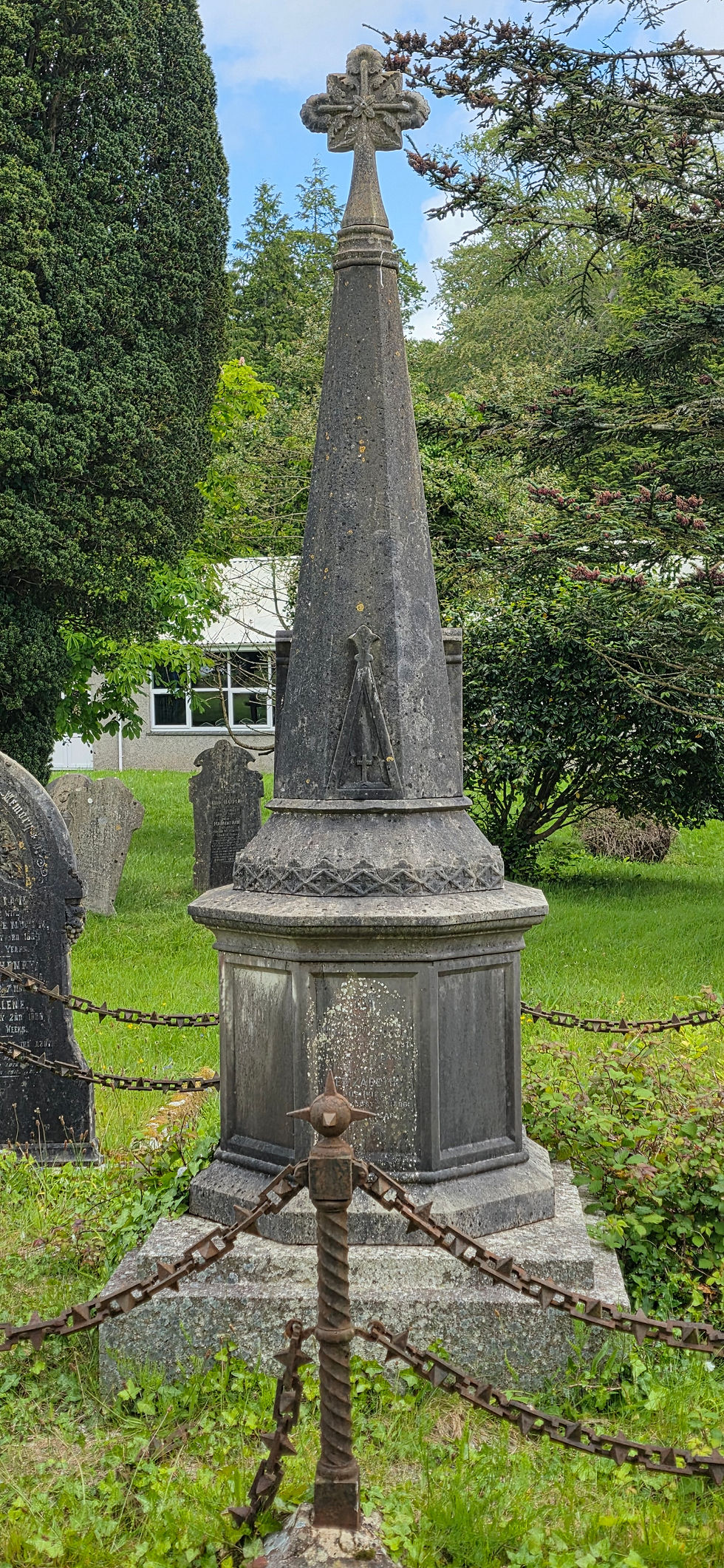
Sadly, while leading the fundraising effort, William suffered a fatal heart attack at his home in Charlestown, number 60, Charlestown Road. The house was originally called the Villa, then the “Lawn” (now the “Beeches”). In the churchyard, the Luke family memorial, shaped like a spire, stands as a tribute to his attempt to complete the church as originally intended. The close location of the Luke memorial to the church shows that the family had a close relationship with St. Paul's during their lives in Charlestown.
The Reverend Coleby and the Second Spire Campaign
In 1913, the Reverend Coleby became vicar of St Paul’s and resolved to renew efforts to add a spire to the church, which had by then stood without one for 62 years. He also faced other pressing needs within the parish, including improvements to the cemetery and the provision of a proper vicarage.
· Coleby first arranged for the removal of the long, narrow banks of earth in the cemetery; these were former burials when people couldn’t afford expensive headstones. The raised banks were the grave markers.
· He then pursued the construction of a new vicarage in 1911, which opened at Campdowns in 1913.
· His third aim was to raise funds for the church spire to complete the church, but the outbreak of the First World War forced the plans to be shelved. Sadly, by the time the war had ended, Coleby had moved on.
Rosemary Cobald-Sawle and the Successful Campaign
In 1968, Rosemary Cobald-Sawle of Penrice Estate, a local landowner and philanthropist, resolved to achieve what earlier generations had been unable to accomplish: the completion of St Paul’s with a spire. To strengthen the appeal, she enlisted the support of local historian A. L. Rowse and the actor and playwright Sir Noël Coward.
Support for the Appeal
Rowse was a St Austell native, born at Tregonissey, who went on to study at Oxford, where he distinguished himself as a historian, especially in Elizabethan studies. He later became an internationally recognised literary scholar and a Fellow of All Souls, Oxford. Living at Trenarren and serving as patron of the appeal during the ministry of the Rev. J. F. H. Rees-Jones, Rowse brought both prestige and local connection to the campaign.
Sir Noël Coward also had longstanding ties to Charlestown. His aunt lived at 161 Pond House at the western end of Church Road, and he spent childhood holidays in the village. He first visited Charlestown in 1907. He developed strong ties with Charlestown over the years, visiting regularly. He even had the premiere for the film “ In Which We Serve” at the Capitol Cinema, not far from Charlestown. Believe it or not, his co-star, Sir John Mills, told me that personally.
Coward’s friendship with Rowse helped strengthen support for the project.
The appeal was ambitious. Its aim was not simply to add a spire, but to complete the church with a proper belfry, a peal of bells, and a steeple. Other things were also completed, including a new Lych Gate and a new pathway.

Construction of the Spire
The contract for constructing the new spire was awarded to Hurley Marine. Its director, George Hurley, was a former Charlestown resident and the son of Charlestown sea captain, Alphonso Hurley. This gave the project another strong local connection. Hurley Marine was a GRP (Glass Reinforced Plastic) boat-building company specialising in yachts, based in Plymouth. The company had started in Charlestown 30 years earlier at what is now the Harbour Brew House (Harbourside Inn). The fibreglass spire was constructed in two sections: the spire itself and the square base section that sat atop the stone belfry. Once installed, laminators glassed the two pieces together. This then took the shape of a witch's hat.
· Rosemary Cobald-Sawle led the campaign.
· A. L. Rowse served as patron of the appeal.
· Sir Noël Coward lent his support to the fundraising effort.
· Hurley Marine carried out the construction work.
Together, these supporters helped raise the £12,000 required for the project. Their efforts succeeded, and on a cold December morning in 1971 the spire was finally added to the church, completing a vision that had remained unrealised for more than a century. I personally stood there outside the church and watched as the spire was lowered into place by a stout crane.
Written by Lyndon Allen.


Comments