

Marques: The Tall Ship That Came to Charlestown
Updated: Aug 12
When I was a boy, a tall ship entered Charlestown harbour. She was the first to do so for a generation. Her name was Marques, and hers is a remarkable story.
My own memories of Marques go beyond simply seeing her in the harbour. I can remember her enormous sails hanging in the old Lovering’s clay-drying facility in Charlestown village when we were children. They were suspended from the roof trusses and, to us, became enormous hammocks. We could climb into them, and they were so large that one could probably have held twenty adults. When you are eleven or twelve years old, that sort of thing is tremendous fun.
I also remember the filming of the storm scenes for the BBC television series The Voyage of Charles Darwin. A rope was tied to the top of the masts and laid out along the road on the western side of the dock. A group of volunteers then pulled and released the rope, causing the ship to roll from side to side to simulate a vessel's motion in a storm.
At the same time, St Austell Fire Service pumped water aboard and powerful wind machines were turned on. To a boy watching from Charlestown, it looked amazing.
These are the sorts of memories that bring Marques's story to life.

The following account has been pieced together from surviving records and, most importantly, the first-hand recollections of people who knew and worked aboard the ship, including myself, Dave Martin, Geoff Ridpath, Dick Farnsworth and Alfie Redman.
Over a long and extraordinary career, Marques evolved from a Spanish wooden trading vessel into a restored square-rigger, commercial cargo carrier, sail-training ship and television star. Her story would eventually end tragically at sea, but not before she had become one of the most distinctive tall ships of her generation.
Much of what we know about her remarkable revival during the 1970s survives in the memories of those who were there. More than half a century later, it is inevitable that some dates and details differ between accounts. The recollections of owner Robin Cecil-Wright, his former wife Virginia, Dave Martin, Geoff Ridpath, Alfie Redman and Dick Farnsworth therefore need to be considered alongside surviving documents, charts and contemporary records.

Origins
There is some disagreement over the precise year in which Marques was built. One account states that she was constructed in Valencia, Spain, in 1917 for the Canary Islands fruit trade, while a surviving technical specification gives the earlier date of 1912 and records her birthplace as Pueblo Nuevo del Mare, Valencia.
Originally a Polacca-rigged brig, she spent many years as a working vessel. Like many wooden ships with long careers, she underwent considerable repair and rebuilding, including major work in 1947.
By the beginning of the 1970s, however, Marques was far removed from the magnificent three-masted barque she would later become.
Robin Cecil-Wright and the Rebirth of Marques

According to the recollections of those involved, Robin Cecil-Wright first saw Marques in Spain in 1971 and bought her the following year.
At that time she carried only a foremast, which was being used as a derrick for loading and unloading cargo. The other masts, yards and great spread of canvas that would later make her such an impressive sight did not yet exist.
Robin travelled down to Spain in his Mini Moke. The little vehicle was loaded aboard Marques, and Robin subsequently brought the ship north to Southampton Water, where she entered Camper & Nicholson’s yard.
There began the extraordinary task of transforming an ageing Mediterranean working vessel into a square-rigged sailing ship.
Dick Farnsworth, together with two other men, constructed the masts and yards, while sailmaker Alfie Redman made her sails. Their work established the rig that would transform Marques into the tall ship remembered by so many people today.
From Southampton to Cornwall
In the autumn of 1973 — recollections suggest either September or November — Marques left Southampton and headed west for Cornwall.
She initially took up a mooring on the River Fal, just above the King Harry Ferry, where she remained for perhaps three or four months. From there she moved to Charlestown, apparently arriving around March 1974, although the precise date has yet to be established.
For Charlestown, her arrival was something remarkable.
The harbour had once been accustomed to sailing vessels, but by the 1970s those days belonged to another age. The sight of a square-rigged ship entering the old granite harbour was therefore an echo of Charlestown’s maritime past — and, for those of us who witnessed it as children, unforgettable.
An intriguing event may eventually allow the date of her arrival to be established more precisely.
Not long after Marques came to Charlestown, the BBC arrived to film an edition of Songs of Praise. During filming, Robin and Dick were asked to take the ship backwards and forwards under power outside the harbour so that the tall ship could appear in the background of the programme.
If the particular edition of Songs of Praise can be identified, surviving BBC production or transmission records may provide independent evidence for the period in which Marques was at Charlestown.
The Pentewan Proposal
During 1974–75, Robin Cecil-Wright was also reportedly negotiating with Sir John Tremayne, owner of Pentewan, over an ambitious proposal to reopen Pentewan harbour for Marques.
It was an intriguing idea, but it never came to fruition. Sir John suffered a serious accident involving his Rolls-Royce and subsequently died. His two daughters inherited the estate but, according to recollections, did not wish to continue with the scheme.
Nevertheless, Marques retained a connection with Pentewan. When not required aboard ship, her sails and running rigging were reportedly stored in sheds beside the harbour until approximately 1977.
There is also my own childhood memory of Marques’ sails being stored in Charlestown. I remember them hanging from the roof trusses of the old Lovering’s clay-drying facility in the village. Their sheer size was difficult to appreciate until you were close to them — or, as we did as children, climbed inside them and used them as enormous hammocks.
24,000 Bottles from Bordeaux
One of the most memorable episodes in Marques’ revived working life came in 1975, when she was chartered by the Sunday Times Wine Club.
Her cargo was an extraordinary one: approximately 24,000 bottles of wine, carried from Bordeaux to Charlestown.
At the time, Marques was described as the last square-rigger to bring a commercial cargo into Britain. Accounts written during the 1980s considered the claim correct, although establishing whether another square-rigged vessel has subsequently imported a commercial cargo into Britain would require further research.
The cook on the Bordeaux voyage was Paula Preston, the elder sister of “Titch”. Paula later married an Australian and emigrated to Australia.
The Bordeaux voyage was significant because it demonstrated that Marques was more than a picturesque recreation of a sailing ship. Decades after the commercial age of sail had effectively ended, she was once again crossing the sea carrying a genuine cargo under square sail.
It must have been an extraordinary sight when she returned to Charlestown — an old-fashioned sailing vessel entering the Cornish harbour with thousands of bottles of Bordeaux wine in her hold.
Becoming Darwin’s HMS Beagle
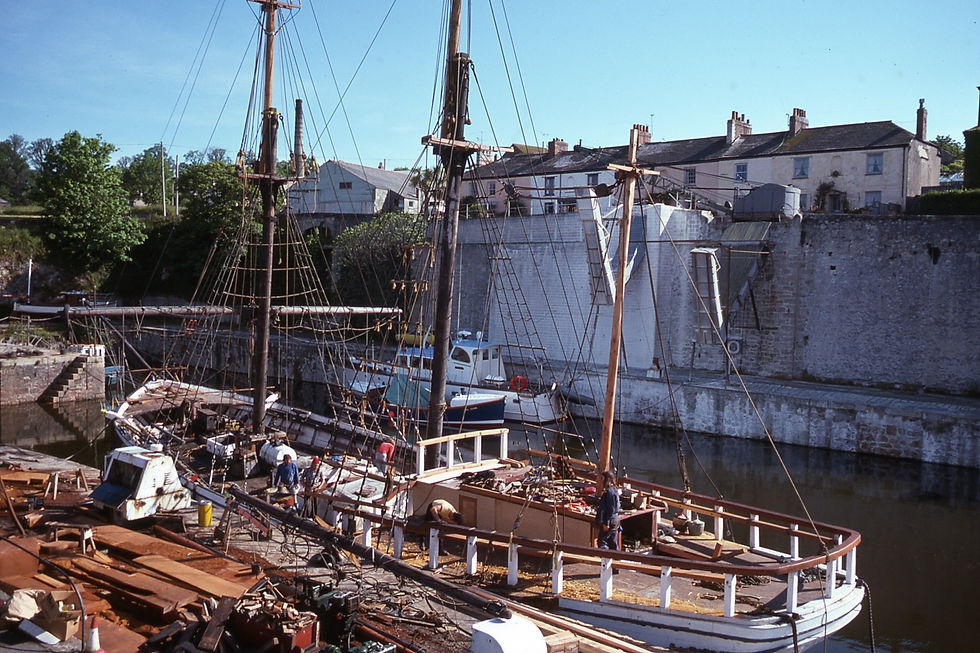
Another remarkable chapter in the ship’s life began when Marques was extensively modified to portray Charles Darwin’s HMS Beagle for the BBC television series The Voyage of Charles Darwin.
The series was broadcast in 1978, although the conversion, filming and voyages associated with the production began earlier.
A surviving chart records Marques leaving Charlestown on 23 July 1977. She returned in July 1978, almost exactly a year later, within a day or two of the anniversary of her departure.
The original chart on which these dates were recorded apparently still survives. If it can be rediscovered, it would provide an especially valuable contemporary record of the ship’s movements during this important period.

The Darwin production was far from Marques’ only appearance before the cameras. Keeping a traditional tall ship operational was enormously expensive, and film and television work became an important means of earning her keep.
Alongside her work as a sail-training vessel for the British China Clipper Society, Marques appeared in numerous television and film productions. Reported credits include The Onedin Line, Poldark, The Fight Against Slavery, The Master of Ballantrae and Dracula.
In little more than a few years, the old Spanish trader had become something of a television star.
The Ship Herself

A surviving technical specification provides a fascinating picture of Marques during this period.
She was described as a British-registered, wooden, three-masted barque, with Fowey, Cornwall, as her home port. Robin Cecil-Wright and Mark Litchfield were named as her owners.
Her recorded specifications were:
Length overall: 120 feet
Length between perpendiculars: 86 feet
Extreme breadth: 24 feet 8 inches
Depth in hold: 10 feet
Draught: 11 feet
Displacement: 300 tons
Gross tonnage: 154 tons
Net tonnage: 85.03 tons
Number of sails: 26
Total sail area: 7,349 square feet
Mainmast height above deck: 81 feet
Although primarily a sailing vessel, Marques was also fitted with two Gardner 6LX diesel engines. Her fuel capacity was approximately 1,000 gallons, giving a stated range of around 1,300 miles under power.
She carried four tons of fresh water and normally sailed with eight crew in addition to the captain, although accommodation was available for as many as 30 people. Facilities included four heads and showers, a saloon area and even a bar.
Professional surveys undertaken in 1972 and 1977 reportedly spoke favourably of the condition of her timbers. Many dated from the substantial rebuilding of 1947, while further timbers and planking were replaced whenever necessary.
Another major refit of her rigging, masts and spars was undertaken in 1981, after which they were reportedly considered to be in excellent condition. Following a professional survey, a new keel was also due to be added during the winter of 1981–82.
For a wooden working vessel already several decades old, Marques had undergone an extraordinary transformation.
The Final Race
By 1984, Marques had crossed oceans, carried cargo, trained young sailors and appeared before millions of television viewers. Her final voyage began as another demonstration of what the veteran square-rigger could still achieve.
She was one of 39 ships taking part in the Bermuda-to-Halifax leg of the biennial Cutty Sark Tall Ships Race.
She had already enjoyed considerable success, winning the first, six-ship leg of the competition from San Juan, Puerto Rico, to Bermuda.
But during the next leg of the race, Marques was lost at sea.
Her loss brought the remarkable career of the old Spanish vessel to a sudden and tragic end. Its consequences, however, extended far beyond the ship herself.
A formal inquiry into the loss was subsequently conducted by the British Department of Transport. One result of the investigation was the development of a Code of Practice for the Safety of Sail Training Ships operating under the British flag.
The new regulations came into effect in January 1991 and covered matters ranging from vessel construction and stability to safety equipment and crew requirements.
In this way, the loss of Marques contributed to changes intended to improve the safety of those who would go to sea in other sail-training ships.
The Legacy of Marques
The story of Marques is unusual even among the great sailing ships of the twentieth century.
She began life as a Spanish-built commercial vessel and spent decades earning her living at sea. By the early 1970s, little remained to suggest the magnificent square-rigger she would become: she had only a foremast, being used as a derrick for handling cargo.
Then Robin Cecil-Wright found her.
What followed was an extraordinary resurrection.
New masts and yards were built, new sails were made, and the old trader once again became a true sailing ship. She came west to Cornwall, lay on the Fal and then entered Charlestown harbour — bringing a tall ship into the port for the first time in a generation.
From there her story grew still more remarkable. She carried 24,000 bottles of wine from Bordeaux, became Darwin’s HMS Beagle, appeared on television screens around the world, trained young sailors and crossed oceans under a towering spread of canvas.
For those who knew her, sailed aboard her, worked on her or simply stood on the harbour wall and watched her arrive, however, Marques was more than a list of voyages and television credits.

For some of us, she is also part of our childhood: the enormous sails hanging from the roof trusses in Charlestown, children disappearing into them as though they were giant hammocks; the volunteers hauling on a rope beside the dock to make the ship roll; the firemen pumping water across her decks; and the wind machines turning a quiet Cornish harbour into a stormy ocean for the cameras.
More than half a century later, those images remain remarkably clear.
Marques travelled far beyond Cornwall and ultimately met her tragic end thousands of miles from Charlestown. Yet for a few extraordinary years she was part of the life of the village.
She belonged, for a time, to Charlestown.
And for me, her story will always begin with the unforgettable sight of a tall ship entering the harbour when I was a boy.
The addition of your memories of playing in the sails and watching the BBC storm sequence being created strengthens the piece considerably. They turn it from a history about Marques into a history partly told by somebody who was actually there.
Written by Lyndon Allen 2026.


Comments