

Have We Got Charlestown's History Wrong?
When I published Charlestown – Time and Tide five years ago, I believed I had uncovered much of the true history of my ancestors' village. The book was the culmination of years of research into Charlestown's past, drawing together original records, maps, newspapers and family documents to tell the story as accurately as the evidence allowed.
But history has a habit of refusing to stand still.
Since the book was published, new evidence has emerged, overlooked documents have come to light, and fresh research has challenged several long-accepted beliefs about the village. Rather than confirming what has been written for generations, much of this evidence suggests that parts of Charlestown's accepted history need to be reconsidered.
That should not surprise us. History is never fixed. Every generation has access to new sources, new technology and new opportunities to examine the past. What one historian accepts as fact may later prove to be incomplete—or occasionally, simply wrong.
Charlestown has been fortunate to have its history recorded by respected writers, including Richard Larn OBE, John Stenglehofen and A. L. Rowse. Their work has shaped our understanding of the village and has deservedly earned its place in Cornish history. They wrote using the information available to them at the time.
My own research has taken a different approach. Wherever possible, I have returned to original documents rather than relying on accounts that have been repeated from one publication to another. Over many years I have examined thousands of original records, maps, shipping lists, legal papers, newspapers and family archives. My aim has never been to prove earlier historians wrong, but simply to discover what the surviving evidence actually tells us.
In doing so, I have found that some of Charlestown's best-known stories withstand scrutiny, while others do not.
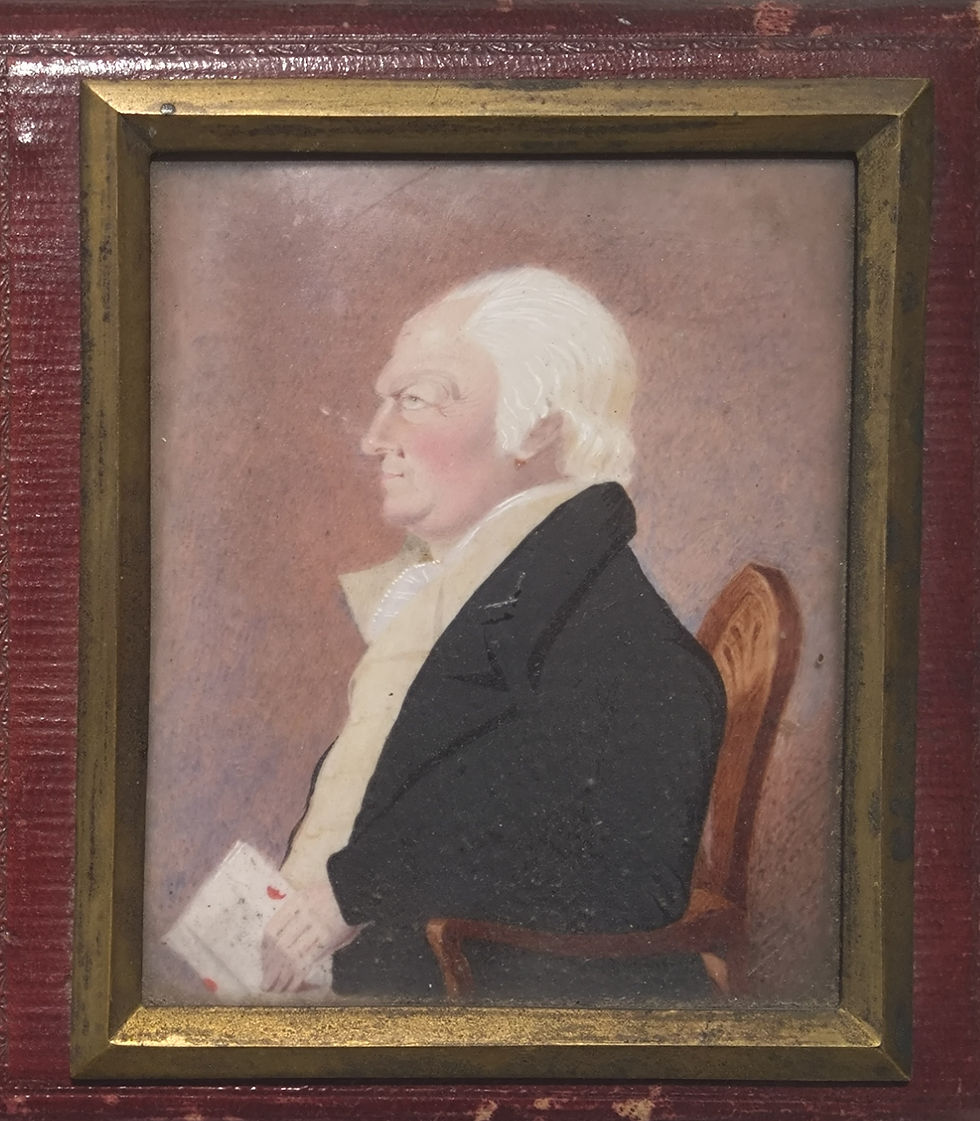
First up: Joseph Dingle Was the Plaintiff, Not Charles Rashleigh
A persistent misunderstanding in accounts of Charlestown’s early history is that Charles Rashleigh initiated legal proceedings against Joseph Dingle to recover the harbour and associated property. Contemporary evidence demonstrates that the opposite was true.
A report of the Bodmin Summer Assizes (15 August) records the case as:
“Roe, on demise of Heale and others, v. Rashleigh. The same v. Thirty-six other persons.”
The newspaper explains that thirty-seven ejectment actions were brought by the assignees of the bankrupt estate of Joseph Dingle against Charles Rashleigh and others to recover possession of houses, buildings, the pier, basin, and other property in the newly created town of Charlestown.
The report summarises Dingle’s remarkable achievements:
“He foresaw the immense benefit to be derived from converting a barren spot into a port and harbour, and, with the assistance of Mr Rashleigh... actually converted that barren spot into a place of the first importance to the County...”
It goes on to explain that relations between the two men later deteriorated. In 1809, according to the report:
“...Mr Rashleigh withdrew his protection from Dingle, arrested him, threw him into prison, and resumed the possession of the whole property.”
Following Dingle’s bankruptcy, his creditors obtained a commission in bankruptcy, and his assignees—standing in Dingle’s legal place—brought the ejectment actions to recover possession of the estate from Rashleigh. Rashleigh defended the actions by claiming a substantial debt against the bankrupt estate and asserting a lien over the lease.
The litigation ultimately turned on technical legal issues concerning the lease and possession. The report concludes that the plaintiffs were successful in twenty-five of the thirty-seven ejectment actions, with the remaining twelve reserved on a point of law concerning formal delivery of possession.
This contemporary account is significant because it demonstrates that Charles Rashleigh was the defendant, not the plaintiff. Although Dingle himself had already been declared bankrupt, the proceedings were brought by his assignees on behalf of his estate. In legal effect, therefore, it was Joseph Dingle’s side that took Charles Rashleigh to court in an attempt to recover the Charlestown properties—not the other way around.
This distinction is important because it corrects the long-held impression that Rashleigh simply sued Dingle to reclaim his property. The historical record shows instead that, after Dingle’s bankruptcy and imprisonment, it was Dingle’s estate that initiated proceedings against Rashleigh to recover possession of the harbour and town that Dingle had played such a central role in creating. This research is ongoing, and I am determined to put this scandalous story to bed very soon.
John Smeaton:
Another aspect of Charlestown’s history that deserves closer examination is the role attributed to the celebrated engineer John Smeaton. Almost every published account credits him with the construction of the harbour. Yet when the surviving evidence is examined, the picture becomes much less certain.
I have read Smeaton’s published papers, his personal journals, and his surviving correspondence. Nowhere have I found any reference to Polmear, Charlestown, or to Charles Rashleigh’s harbour project. This absence of evidence does not prove that Smeaton had no involvement. He may well have visited the site and offered informal advice, or there may once have been correspondence between him and Rashleigh that has since been lost. Until such evidence comes to light, however, his involvement must remain a matter of speculation rather than fact.
There is, however, one long-standing claim that can be dismissed with confidence. Smeaton was not responsible for the design of the port leat. The contemporary records leave little doubt that this was the work of William Hansen, whose engineering skill provided the water supply essential to the operation of the harbour.
Hansen’s contribution has been largely overlooked, perhaps because Smeaton’s reputation has encouraged later historians to attribute achievements to him without documentary support. While Smeaton may yet prove to have had some advisory role, the evidence presently available gives the credit for the port leat to William Hansen alone.
History should be guided by evidence rather than repetition. Until new documentary material emerges, Smeaton’s connection with Charlestown should be regarded as an intriguing possibility—not a fact—whereas William Hansen’s authorship of the port leat deserves full recognition.
Take the name West Polmear, for example. It has been claimed very recently (2024) that the village was never known by that name and that it was a later invention. Yet three independent maps of St Austell Bay in my possession, all dating from the 1770s, clearly identify the settlement as West Polmear—decades before Charlestown was created. Those maps settle the question beyond reasonable doubt.
The accepted date for the construction of Charlestown Harbour also appears to require correction. Almost every published history states that work began in 1790. However, The Gentleman's Magazine of July 1801 records that construction commenced in the spring of 1791, following the disastrous winter storms of 1790 in which four ships were lost on the beach. A contemporary source written only a decade after the event carries considerable weight and strongly suggests that 1791 is the correct date. It was written by Dr William George Maton, a highly esteemed geologist. I have no cause to doubt his word. He visited Charlestown at the time.
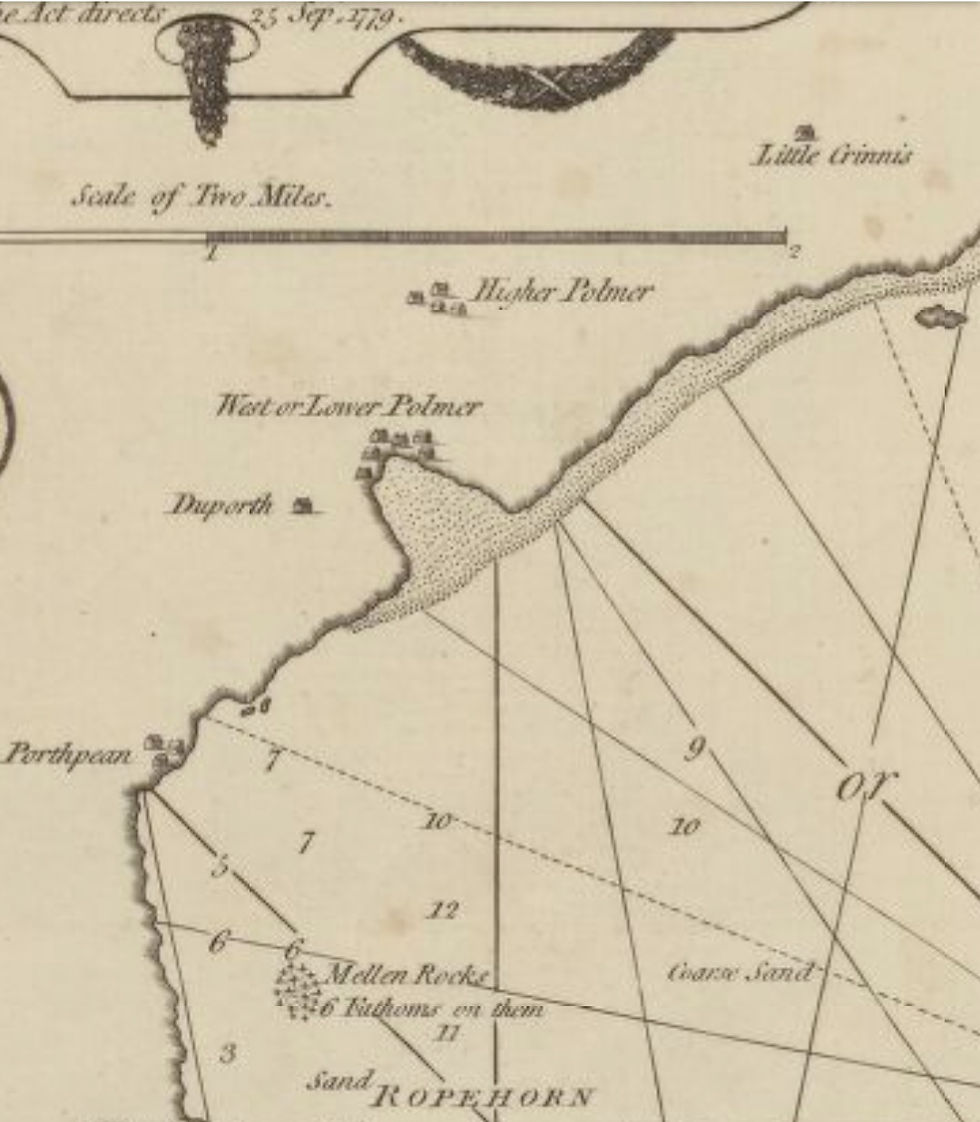
The fate of the excavated rock during the construction of the dock and basin has also been misunderstood. It has long been claimed that the material was transported inland for building work around St Austell. The evidence suggests otherwise. Modern hydrographic charts reveal an extensive submerged reef approximately half a mile south of Charlestown, covering some 300 metres in width and extending for almost half a mile. Yet a nautical chart of 1779 records the seabed there simply as "course sand". The reef did not exist before construction of the harbour. Combined with newspaper reports describing spoil from the 1873 harbour extension being dumped offshore, the evidence strongly suggests that the original excavations were deposited at sea, creating the artificial reef that remains today. As well as providing a convenient place to dispose of the spoil, it would also have created new fishing grounds for an increasing population and a safer anchorage for shipping.

The often-repeated claim that just nine people lived at Polmear when Charles Rashleigh purchased the land in 1779 has never entirely convinced me. While I do not necessarily dispute the figure itself, I question what it actually represents. Contemporary maps, documentary references, the 1720 beach watch listing twenty named men, the presence of Higher and Lower Polmear, the working farm, the coal trade and, above all, the labour-intensive pilchard industry all suggest a place that was far busier than the traditional story implies. Rather than representing the total population, I believe the "original nine" may simply refer to permanent residents or tenants, while many others travelled to and from Polmear each day to work. If so, the accepted interpretation has overlooked the difference between a small resident community and a thriving working settlement.
The changing of the village's name tells a similar story. Historians and history groups have said even recently a date of 1801. Yet Charles Hatchett, visiting in May 1796, recorded the settlement as "Charles Town" in his diary, while three newspaper reports published in 1798 also referred to it as Charlestown. These contemporary references demonstrate that the new name was already in use by 1796. Hatchett was also a travelling companion of Dr Maton.
Other familiar stories have also proved to be less certain than many people realise. The well-known account of Admiral Sir Edward Pellew entering St Austell Bay in HMS Indefatigable has been dated to 1840 in later histories, despite the fact that Pellew died in 1833. Contemporary evidence instead places the incident in 1797, when a vessel of the Channel Squadron entered the bay without displaying the correct colours and was mistakenly fired upon by the volunteer battery before the error was recognised.
Even twentieth-century history has acquired its own myths.
It has long been claimed that the world’s first china clay slurry pipeline was connected to Charlestown in 1906. However, after many hours of painstaking research, I discovered that this date is incorrect.

The pipeline was actually connected in 1900. This is confirmed by the Charlestown Foundry minute book, which I recently acquired. An entry dated July 1900 clearly records that the drier associated with the pipeline was built and connected on the foundry site during 1900.
It is frequently stated that Charlestown was the first place in Cornwall to be bombed during the Second World War. In reality, Falmouth Docks were attacked earlier at 7 am on the morning of 5 July 1940, with Charlestown being bombed later the same day. At 10:11 am, a Heinkel 88 bomber aircraft dropped three high explosive bombs over Charlestown—two fell in a wheat field, and one landed on the lawn of Major McDougall’s residence, The Grove, which at the time was serving as a children’s Nightingale, a temporary wartime nursery or hospital for children. The sky was intermittently cloudy, and there was no chance to sound the air raid siren in advance. By 10:13 am, the ARP Warden, Joseph West, spotted the bombs falling from the aircraft.
Another story is the brothels at 11 Doors Lane known as “Chinatown.” Rowse was correct in saying there was a brothel there. However, it was just one incident from what I can find out. It was also during the Second World War, in 1942. Censorship was high in the media, so quite possibly overlooked. I don't think the so-called brothel went on very long at all.
July 29th, 1942. The St Austell Gazette wrote:
ST. AUSTELL WOMEN SENT TO PRISON.
A sentence of three months’ imprisonment was passed by St. Austell magistrates on Wednesday on Winifred Mary Pedlar for keeping a house of ill repute at 127 Charlestown Road, St. Austell, on July 12th, and to five months' imprisonment for allowing a child over four years of age and under 16 to reside at that house. A total of eight months. She pleaded guilty to both charges. Margery Watkins, 57 Tremayne Place, St. Austell, was sentenced to three months’ imprisonment for assisting in the management of the house on July 12th. She pleaded not guilty. Sergeant Ebbett and P.C. Thomas, who gave evidence, were commended by the Bench for their work in connection with the case and for the manner in which they had brought it forward.
This episode shaped the history of Charlestown once again, as I went looking for an earlier brothel. This I found, and it was down closer to the dock, opposite the Rashleigh Arms. This was “Chinatown.” Another chapter in Charlestown’s colourful past revealed.

Likewise, the oft-repeated claim that Charlestown Church's fibreglass spire was lowered into place by helicopter in 1971 is contradicted by contemporary photographs and reports, which show it being lifted by crane.
These examples are not presented to diminish the work of previous historians. Quite the opposite. Historical research is a continuing process. Every discovery builds upon the work of those who came before, and every newly discovered document has the potential to improve our understanding of the past.
Charlestown deserves a history founded on evidence rather than assumption. Tradition has an important place in telling a community's story, but tradition and history are not always the same thing. Where original documents survive, they should always take precedence over stories that have simply been repeated through the years.
Perhaps that is the greatest lesson of all. History is not something we inherit unchanged; it is something we continually rediscover. As new evidence emerges, our understanding must evolve with it. Charlestown's remarkable story is no exception.
Written by Lyndon Allen, August 2026.


Comments